• Skip to primary navigation
  • Skip to main content
  • Skip to primary sidebar

Catechist's Aide

a Resource Site for Catechists

  • Email
  • Instagram
  • Pinterest
  • Twitter
  • YouTube
  • HOME
  • Blog
  • Bible Study
  • Classroom Tips
  • Essential Tools for Catechists
  • Shop
  • ABOUT
You are here: Home / Blog

Blog

The Precepts of the Catholic Church

By Catechist's Aide on May 30, 2017 0

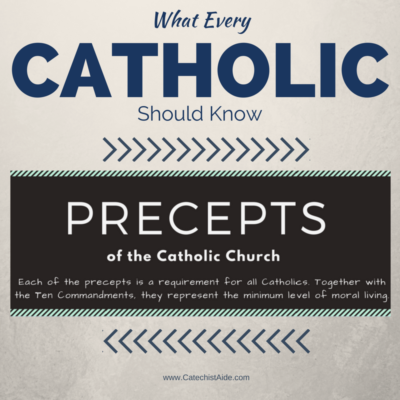
If you find yourself with 5 or 10 minutes to fill at the end of class, take that time to teach your students about the Precepts of the Catholic Church.  The Catechism says, “The precepts of the Church are set in the context of a moral life bound to and nourished by liturgical life.” CCC 2041

They remind us that we should have within us a commitment to prayer, and participation in the liturgy and the Sacraments. And they represent the required behavior for all faithful Catholics. If time permits, discuss with the students how one might go beyond these required minimums.  For instance,

  1. Go to confession on a regular schedule, say every three months.
  2. Attend Mass on First Fridays or First Saturdays, or on special feast days (in addition to Holy Days of Obligation).
  3. Schedule time to pray each day.
  4. Make a daily examination of conscience (Daily Examen).
  5. Spend some time alone with our Lord by attending Eucharistic Adoration.
  6. Learn a new prayer and commit it to memory.
  7. Volunteer your time at your local parish.

Click on the link below to download an infographic.  Feel free to use it as a handout for your students.

Precepts of the Church

3 Reasons Why the Ascension Really Matters

By Catechist's Aide on May 22, 2017 0

Forty days after Easter we celebrate the Solemnity of the Ascension of the Lord. When we think of Easter our thoughts go immediately to Christ’s suffering and death on Good Friday and of course his glorious resurrection on the third day. By the time we reach Easter, after the long season of Lent, we are all ready to celebrate some good news, or shall I say The Good News. We are thankful for the great redemptive sacrifice of Jesus and reminded that one day we will all share in the resurrection. We tend to view Easter as the full and final culmination of God’s saving plan, reducing the Ascension to nothing more than Jesus going back to the Father for a pat on the head for a job well done.  It is no surprise then, that the Ascension is, possibly, the most overlooked feast of the Liturgical year. But, the Easter season does not end with Easter Sunday. And, we sometimes forget that the Paschal Mystery does not conclude with Christ’s Resurrection, but with his Ascension.

“The wonderful works of God among the people of the Old Testament were but a prelude to the work of Christ the Lord in redeeming mankind and giving perfect glory to God. He accomplished this work principally by the Paschal mystery of his blessed Passion, Resurrection from the dead, and glorious Ascension, whereby ‘dying he destroyed our death, rising he restored our life.’ For it was from the side of Christ as he slept the sleep of death upon the cross that there came forth ‘the wondrous sacrament of the whole Church” – Catechism of the Catholic Church 1067

Here then are three reasons why the Ascension really matters:

1. It gives us hope that we too will share eternal life in heaven.

Perhaps the most overlooked message of the Ascension is that when Jesus ascended into heaven, he brought his earthly body, his humanity, into the heavenly realm. Jesus’ human nature was not a costume that he wore on earth and then cast off before he returned home. Jesus did not play the role of a man for 33 years and then go back to his day job after the Ascension.

The Jesus that the apostles witnessed after the resurrection was not a ghost, nor was he a resuscitated corpse.  He was the same, yet different.  He walked and talked with his friends, and ate and drank with them, but he could also enter a room through a locked door. The apostle Thomas even examined the crucifixion wounds of the risen Christ. It’s important to remember that the Hypostatic Union continues in heaven.  Jesus returned to heaven as God AND man.  This gives us hope that one day we too will enjoy eternal life in our own resurrected bodies.  Jesus told the apostles that he was going to prepare a place for them. Without the Ascension how could we enter heaven?

“In my Father’s house there are many dwelling places. If there were not, would I have told you that I am going to prepare a place for you? And if I go and prepare a place for you, I will come back again and take you to myself, so that where I am you also may be. Where [I] am going you know the way. Thomas said to him, “Master, we do not know where you are going; how can we know the way?” Jesus said to him, “I am the way and the truth and the life. No one comes to the Father except through me” – John 14: 2-6

2. From his place at the right hand of the Father, Jesus intercedes for us.

After his Ascension, Jesus took his place at the right hand of the Father. It is from this position that Jesus intercedes on our behalf, and we can have confidence that the Father hears us and will have mercy on us. Jesus, who through the Incarnation became man, understands us. Who better to intercede for us?

“Therefore, since we have a great high priest who has passed through the heavens, Jesus the Son of God, let us hold fast to our confession. For we do not have a high priest who is unable to sympathize with our weaknesses, but one who has similarly been tested in every way, yet without sin. So let us confidently approach the throne of grace to receive mercy and to find grace for timely help.” – Hebrews 4: 14-16

3. After his Ascension, he sent us the Holy Spirit.

He sent us the Holy Spirit to be our guide. Before his Ascension, Jesus told the apostles that it would be better for them if he went back to the one who sent him. But, he also promised that he would not leave them orphans.  He would send someone to guide them.

“But I tell you the truth, it is better for you that I go. For if I do not go, the Advocate will not come to you. But if I go, I will send him to you. … But when he comes, the Spirit of truth, he will guide you to all truth. He will not speak on his own. But he will speak what he hears, and will declare to you the things that are coming.” John 16: 7, 13

The Holy Spirit is the living presence of God in the world today. He gives grace to those who are receptive to him.  He guides the Church (and each of us) to the truth – not “my truth” or “your truth” but THE truth. Through the power of the Holy Spirit the Apostles were able to continue Christ’s ministry and grow his Church on earth. That same power is available to us today. We sometimes ask ourselves how would we respond if Jesus were in our midst, as he was with the Apostles. Well, the Holy Spirit is in our midst right now, and he is speaking to us. He offers us the same guidance and strength that he gave to the Apostles two thousand years ago. As we celebrate the Ascension of  our Lord, it’s a good time to ask ourselves how receptive are we to his gifts?

© 2017 Catechist’s Aide

The Prodigal Son

By Catechist's Aide on March 7, 2017 0

As we now find ourselves in the penitential season of Lent, it is the perfect time to review the Sacrament of Reconciliation and discuss God’s infinite mercy. A few weeks ago, in preparing my class of 7th and 8th graders to go to Confession, we did just that. I think this age group is ready to move past viewing sin as merely behaving badly, and toward a view of sin as a rejection of God and his love. I am pleased to report that after Confessions, the priest addressed the students and thanked them for taking the Sacrament so seriously.  He told them that he could tell that they had prepared well, and he encouraged them to come back to Confession often.

In the course of our preparation, I couldn’t pass up the chance to look in-depth at the parable of the Prodigal Son.  I prepared a Lectio Divina on the parable and we broke into small groups to read and discuss. I was happy to see the kids engaged and able to relate to all of the characters in the parable, the young son, the older brother and the father.

Below is a link to the Lectio Divina.  Feel free to download a copy and please let me know how this works in your class.

Lectio Divina – The Prodigal Son

Be Prepared … to Change

By Catechist's Aide on February 9, 2017 0

Lesson planning is essential to success in the classroom, but sometimes plans need to change if you’re not getting the desired result or if things outside your control change.  Always have a backup plan.  Many times I’ve been told minutes before class is about to begin that there will be a 15 minute presentation to all students about the Giving Tree, Rice Bowls or Youth Camp, etc.  This means I now have to fit a 60 minute lesson plan into just 45 minutes.  There could also be technical difficulties, even traffic and weather issues that impact your class, so flexibility can be key.  Be prepared in advance to know where you can shorten your presentation without losing any of the fundamental learning objectives.

Also, be prepared with activities to fill time if need be.  I like to carry a packet of jeopardy style questions that I can pull out if we have extra time at the end of the lesson.  Other things you can do to stretch time:

  • Quiz the students on who can recall Sunday’s gospel reading, and then discuss its meaning in more detail.
  • Ask students if they would like to share their community service experiences with the class.
  • Have prepared filler segments like, “Why do Catholics Do That?” to explain to the class why Catholics genuflect, bless themselves with holy water, say the rosary, use incense, etc.
  • If the Church or the Pope is in the news, you may want to spend a few minutes discussing current events within the Church.
  • Introduce a new prayer to your class, share its background and history, and then pray it together.
  • Teach the students about a saint.

© 2017 www.CatechistAide.com


3 Tips for Engaging Your Students From the Start

By Catechist's Aide on February 4, 2017 0

You may be familiar with the quote from motivational author, Louise Hay:

“How you start your day is how you’re going to live your day. And how you live your day is the way you live your life.”

I’m a firm believer that how you start your class can make all the difference in how that class goes.  Mindset does matter, and establishing a positive mindset that is open to learning at the beginning of class, can help set the tone for the rest of class. So, here are 3 tips for engaging your students from the start.

    1. Open with Prayer – As catechists, we should never pass up any opportunity to bring prayer and periods of reflection into the classroom.  Opening class with a prayer helps to set the mood and tone for the next hour.   If the class is large, I generally lead the prayer myself, rather than have everyone join in.  One of my favorite prayers to use at the beginning of class is:
      Lord Jesus, we invite you into our classroom today.
      Bless our minds and fill them with knowledge and wonder about your world.
      Open our eyes to all our education offers us each day, and help us learn your ways.
      Fill our mouths with kind words that show appreciation to our teachers, classmates, and friends.
      Forgive us when we forget that you are our guest.
      Thank you for dwelling in our hearts, our classroom, and our school with your spirit, grace, and love.
      We ask all of this through you, our greatest teacher of all.
      Amen.

      Adapted from: Manion, Betty  (2012-04-26). Prayers Before the Bell: Inviting Christ Into the Classroom (Kindle Locations 142-156). Liguori Publications. Kindle Edition.

      There are many options for  prayers for the classroom.  You can use the Sunday Gospel reading, or tailor a prayer or verse from Scripture that relates to that day’s lesson.  Feel free to be creative and enhance the prayer by having individual students lead the prayer, light a candle, or read an accompanying verse from scripture.
    2. Introduce the Topic – Get Their Attention – After you’ve set the mood with an opening prayer – dive straight into your Introduction.  This is where you get your students’ attention.  This can be through a short video clip, a song, an anecdote, a Bible verse, asking a thought provoking question of the class, a quote, or even a joke. The idea here is to use something impactful to get their attention, and motivate them to want to listen and hear more.
    3. Tell Students What You Expect Them to Learn – Now that you have your students’ attention, preview the lesson for them.  Tell them what they will learn today, and how they will demonstrate that they’ve learned it.    This can be as simple as saying, “Today we will begin our study of the Apostle’s Creed.  We will discuss many things, but your objective today is to be able to identify the four pillars of the Catholic faith, distinguish between Theological, scientific and philosophical truths, explain what it means that our faith is both monotheistic and Trinitarian, and explain in your own words why God, who is almighty and all powerful, gives us free will.”  The idea here is to let the class know they have a responsibility and lets them know what they need to focus on.

© 2017 www.CatechistAide.com

Setting the Tone for Class

By Catechist's Aide on January 26, 2017 0

Establish Rules for Classroom Behavior Up-Front

Let your students know, from the first day of class, what your expectations are in terms of their behavior in the classroom.  It may be helpful to either make them sign a “Classroom Contract” indicating they understand the rules of the classroom, or keep a poster with the rules visible in the room.  Sure, you’ll have to remind them throughout the year, but be clear, be consistent, and keep reminding them until it becomes a habit.  It’s like teaching your children to put on a seatbelt in the car. You don’t just say it once, you say “Okay everyone buckle up” every time you get in the car until they do it without even thinking about it.

Some rules that I find helpful for middle school students:

    • No Distractions. All schoolbooks, homework, cell phones and tablets, and any other type of distraction (including snacks) should be put away when class begins – items that are not put away WILL be taken away until class is over.
    • LISTEN = SILENT. The word “listen” contains the exact same letters as the word “silent” and when I’m talking, you should be listening – in other words be silent.  There will be many opportunities for you to speak out; when I am talking is not one of them.
    • Visitors to the classroom. From time to time we may have visitors to our class.  When any visitor, whether it is Father, a guest speaker, or one of your parents, enters our classroom, everyone needs to immediately quiet down and give our guest your full attention and respect.
    • Respectful use of the classroom. Other students, or parish groups, use our classroom for various activities.  Do not touch or move anything that does not belong to you.  At the end of class, all students should return chairs to their original location, and tidy up their area. Any trash should be placed in trash receptacles.
    • Behavior in Church/Chapel – Students’ behavior during visits to Church should reflect that they are in a sacred and holy place.  Silence should be observed, and students should display proper reverence by genuflecting before the Tabernacle and bowing before the altar.  Remember that as middle school students you serve as an example for the younger children.

© 2017 www.CatechistAide.com

  • « Go to Previous Page
  • Page 1
  • Interim pages omitted …
  • Page 8
  • Page 9
  • Page 10
  • Page 11
  • Page 12
  • Go to Next Page »

Primary Sidebar

Stay Informed

Join us as we work to bring our students and children closer to Christ. We promise to only send you emails when we have exciting new resources to share with you, and you can opt out at any time.

Check out my Spotify Playlist

Songs suitable for youth groups or retreats:

Categories

  • Bible Study
  • Classroom Tips
  • Downloads
  • Essential Tools for Catechists
  • General
  • Liturgical Calendar
  • Music
  • Prayer
  • Sacraments
  • The Creeds
  • What Every Catholic Should Know

Recent Posts

  • Featured Song – November 2018
  • Discussion Worksheet on Identity for Middle School Students
  • Featured Song – October 2018
  • Reflection for the 28th Sunday in Ordinary Time Mark 10:17-30
  • The Marks of the Church: The Church is Apostolic

Archives

  • November 2018
  • October 2018
  • September 2018
  • August 2018
  • July 2018
  • March 2018
  • January 2018
  • December 2017
  • November 2017
  • August 2017
  • July 2017
  • June 2017
  • May 2017
  • March 2017
  • February 2017
  • January 2017
  • December 2016


Copyright © 2017 Catechist’s Aide  |  All Rights Reserved  |   Legal   |   Privacy

  • Email
  • Instagram
  • Pinterest
  • Twitter
  • YouTube

Copyright © 2026 · Smart Passive Income Pro on Genesis Framework · WordPress · Log in