• Skip to primary navigation
  • Skip to main content
  • Skip to primary sidebar

Catechist's Aide

a Resource Site for Catechists

  • Email
  • Instagram
  • Pinterest
  • Twitter
  • YouTube
  • HOME
  • Blog
  • Bible Study
  • Classroom Tips
  • Essential Tools for Catechists
  • Shop
  • ABOUT
You are here: Home / Archives for 2017

Archives for 2017

Jesse Tree December 1

By Catechist's Aide on December 1, 2017 0

For the past few years we have adopted the tradition of putting up a Jesse Tree in addition to our Christmas tree.  I find that it really helps build a sense of anticipation as we await Christmas Day.  Advent doesn’t officially start until Sunday, December 3 this year, but I am going to start my Jesse Tree today on December 1st.  I hope you’ll follow along with me with a short reflection each day.

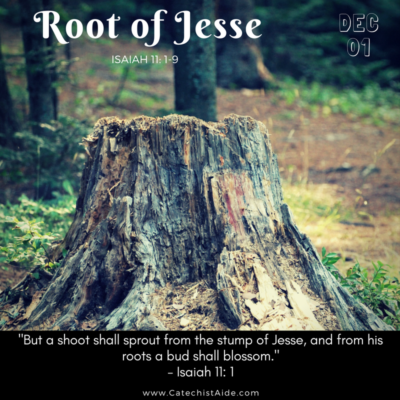
December 01: The Root of Jesse

Traditional Ornament: Tree Stump

Reading: Isaiah 11: 1-9

“But a shoot shall sprout from the stump of Jesse, and from his roots a bud shall blossom.” (Isaiah 11: 1)

God always has a plan. He had a plan for Jesse and his son, David, and He has a plan for us. As we wait this Advent season for the coming of the Christ child, we imagine how long God’s people waited for a Savior. It’s hard to wait, and sometimes that’s what God asks us to do, to wait, so that we will be ready when He sets His plan for us in motion.

© 2017 Catechist’s Aide
Symbolism of the Advent Wreath

By Catechist's Aide on December 1, 2017 0

Advent is a time of joyful anticipation, a period of preparing for the coming of Jesus – the Messiah. We are hopeful as we await the celebration of the birth of Jesus, and we look forward to the second coming of Christ when the Kingdom of God will be permanently established.

The Advent wreath is the traditional and most symbolic devotion of the season. In fact, every part of the wreath is symbolic.

CIRCLE:

The circular shape of the wreath symbolizes God’s eternity with no beginning and no end.

EVERGREENS:

The wreath is made out of evergreens which symbolize the new life of eternal salvation available to us through Christ.

CANDLES:

The candles on the wreath are lit when we say the Advent prayers. The light of the candles symbolizes that Christ is the light of the world.

FOUR:

The wreath has four candles which represent the four Sundays in the Advent season.

PURPLE:
Three of the candles are purple. These are lit during the 1st, 2nd, and 4th weeks of Advent. Purple represents prayer, penance, and preparation for the coming of the Lord.

ROSE:
The candle that is lit during the 3rd week of Advent is pink or rose. The third Sunday of Advent is also known as Gaudete (Latin, “rejoice”) Sunday. At this time, it’s appropriate to take a break and rejoice as we recognize that we are past the midway point of the season and the arrival of the infant Jesus is near.

Following are links to prayers to say while lighting the candles on the Advent wreath:

Prayers for Lighting the Advent Wreath Candles

Family Advent Guide Prepare the Way for the Lord!


© 2017 Catechist’s Aide

Liturgical Calendar

By Catechist's Aide on November 30, 2017 0

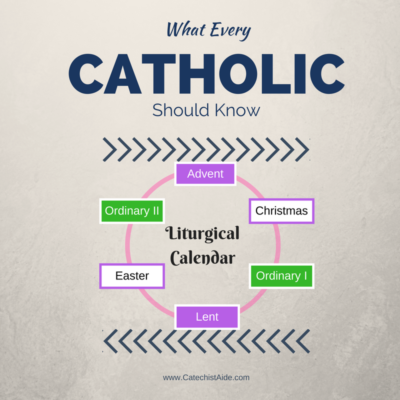
Having just celebrated the Feast of Christ the King, we are looking forward to the beginning of a new liturgical year and the start of the season of Advent.  Even though our students may notice the change in colors of the priest’s vestments from time to time, they may never make the connection that those colors are tied to particular seasons. So here’s what every Catholic should know about the Liturgical Calendar.

The Church has its own calendar, which incorporates all the seasons, feasts and saints and holy days that we celebrate throughout the liturgical year. The readings we hear at Mass correspond to the special season or holy day. Likewise, the color of the Priest’s vestments also change with the season.

ADVENT (Colors: PURPLE / PINK)

The liturgical year begins with the season of Advent, which officially begins four Sundays before Christmas and ends on Christmas Eve. In 2017, Advent will begin on Sunday, December 3rd. The word “advent” comes from the Latin word “adventus” which means coming or arrival.  During the season of Advent, we prepare for the coming of our Savior, Jesus Christ. Unlike Lent, which is primarily a time of penance, Advent is a time of hope-filled anticipation.

CHRISTMAS (Color: WHITE)

As far as the Church is concerned, Christmas is not just a day, but a whole season! The season begins on Christmas Day and ends with the Feast of the Baptism of our Lord. The Christmas season also includes the Feast of the Epiphany, where we celebrate the Christ’s making himself known to the world, through the visit of the Magi. During the Christmas season, we celebrate the birth and manifestation of Jesus.

ORDINARY TIME I (Color: GREEN)

The first season of Ordinary Time begins the Monday following the Feast of the Baptism of our Lord and ends the day before Ash Wednesday. During Ordinary Time, we remember the life and teachings of Jesus.

LENT (Color: PURPLE)

The season of Lent begins on Ash Wednesday and continues through Holy Week. During this season, we prepare for the death and Resurrection of Jesus. Lent marks a time when we are called to penance, through prayer, fasting, and almsgiving.

TRIDUUM (Colors: PURPLE / RED)

The final days of Holy Week, including Holy Thursday, Good Friday, and Holy Saturday, when we recall the crucifixion and death of our Lord and Savior.

EASTER (Color: WHITE)

The Easter season marks the greatest feast of the Liturgical year when we celebrate the Resurrection of Christ. The exact date of Easter varies from year to year and is defined as the Sunday following the first full moon after the vernal equinox (the day in Spring where there are equal hours of daylight and moonlight – typically March 20th). The Easter season lasts for 50 days, ending on Pentecost Sunday. We also celebrate the feast of the Ascension during the Easter season.

ORDINARY TIME II (Color: GREEN)

Following Pentecost Sunday and running through the feast of Christ the King is the second season of Ordinary Time.

To find more information about the Liturgical Calendar, or to see the full list of holy days and feast days, consult the website of the US Conference of Catholic Bishops

© 2017 Catechist’s Aide

Opening Prayer for New PSR School Year

By Catechist's Aide on August 18, 2017 0

Most Parishes are starting up their PSR programs for the 2017/18 school year. As Catechists, that means we are planning and preparing as well. Now is as good a time as any to think about how you will open that first class. The prayer that follows is a wonderful way to begin the first day back in PSR and remind your students that we indeed must be thankful for the opportunity to gather together and learn more about our Lord and Savior – something that is not available to so many people around the world.

I am reprinting the prayer below, but full credit goes to the author, David Bennett, who originally posted it here.

Father,
We thank you for the opportunity
to begin this new school year,
and we ask that you bless
the students, faculty, and student families
that make our school a great place.
We pray that you will guide us in your ways,
so that we will seek your will
in everything that we do,
and love others as you love us.
We ask this in the name of Jesus Christ our Lord. Amen

David Bennett

© 2017 Catechist’s Aide

Icebreakers

By Catechist's Aide on August 17, 2017 0

It’s here already!  Catechists are getting ready to start a new school year of Religious Education, and that means breaking out the icebreaker games.

Most first classes typically involve some kind of icebreaker activity to help the students get to know one another.  A lot of these activities involve the student sharing personal information with the class, which can present a challenge for many middle school students who are self-conscious and may be reluctant to share sensitive or personal information with a new group of people.

Still, it’s important for the students to begin to build relationships with their classmates, and we typically start by learning each others’ names.

The following game, is an easy no-pressure activity, that you may want to try with your students.

Names in Motion

After explaining the rules to everyone, have all the students stand in a circle. One person is selected to start (or even better, the Catechist can lead off).  He or she walks into the middle of the circle and states his or her name and then makes a gesture, such as

  • Clapping your hands twice
  • Snapping your fingers
  • Flipping your hair
  • Giving a “thumbs up” sign
  • Rubbing your belly
  • Bowing
  • Doing the “Thinker” pose

Countdown 1 … 2 … 3 and then everyone in the circle repeats the person’s name and the gesture. If the group is not too large, you may wish to go around the circle with each person repeating the name and performing the gesture.

The person standing in the middle returns to the circle, and then the Catechist can tap the next person to move to the center and state his/her name and perform a gesture.  Rinse/repeat until everyone has introduced themselves.

© 2017 Catechist’s Aide

What About Bathroom Breaks?

By Catechist's Aide on August 1, 2017 0

The topic of bathroom breaks will inevitably come up, so it’s best to have a policy in place from the start. Be sure to let your student know all of your class policies from the first day you meet and then follow up with an email to parents so that everyone is on the same page.

First, if you don’t know whether or not your Parish already has rules or policies in place regarding bathroom breaks during Religious Education classes, then, by all means, speak with the Director of Faith Formation and find out. He or she may also have great insight into what works or doesn’t work, so take advantage of them as a resource.

My problem with bathroom breaks is the interruption to the class when a student raises their hand to ask permission to go. I have found two solutions that have made this less of an ordeal – for the student, for the Catechist and for the rest of the class.

  1. Use a Hall Pass. With middle school students, I have found them to be responsible enough to simply grab a “Hall Pass” that is kept at the front of the classroom, and excuse themselves. There is no need to ask permission, simply take the Pass and go – silently and without interrupting the rest of the class. The Hall Pass is returned to its original position when the student returns and is available for the next person who may need to go. I tell the students that the Pass is a privilege, and as such, can be taken away if it is abused. This process has worked very well for my classes. Abuse has been rare, in fact, most students appreciate skipping the embarrassment of having to ask permission, and thus use the Pass responsibly. Another reason that I like this option is that it gives the student a small bit of independence at an age where independence is highly valued.  A few caveats: this may not be the best option if your class is very large or if you don’t have an Aide or parent volunteer to keep up with the student’s comings and goings. In some parishes (like mine) there are parents serving as Hall Monitors during class time. If you have the same arrangement in your Parish, then the Hall Pass solution may work for you.
  1. Have a set time for a bathroom break. This will not completely put an end to disruptions in the middle of class, but it can cut the number way down. The biggest drawback to this option is that you are giving up valuable minutes of class time. Still, it may be worth sacrificing those minutes if it helps to provide a focused and attentive group of students for the remainder of the time.  This option works well if your class time is longer than an hour and a half.

So there you have it – two options to consider when deciding on how to deal with bathroom breaks.  I’m sure there are other more imaginative solutions out there as well. I would love to hear what works for you.  Be sure to let me know in the Comments section.

© 2017 Catechist’s Aide

  • « Go to Previous Page
  • Page 1
  • Interim pages omitted …
  • Page 3
  • Page 4
  • Page 5
  • Page 6
  • Page 7
  • Page 8
  • Go to Next Page »

Primary Sidebar

Stay Informed

Join us as we work to bring our students and children closer to Christ. We promise to only send you emails when we have exciting new resources to share with you, and you can opt out at any time.

Check out my Spotify Playlist

Songs suitable for youth groups or retreats:

Categories

  • Bible Study
  • Classroom Tips
  • Downloads
  • Essential Tools for Catechists
  • General
  • Liturgical Calendar
  • Music
  • Prayer
  • Sacraments
  • The Creeds
  • What Every Catholic Should Know

Recent Posts

  • Featured Song – November 2018
  • Discussion Worksheet on Identity for Middle School Students
  • Featured Song – October 2018
  • Reflection for the 28th Sunday in Ordinary Time Mark 10:17-30
  • The Marks of the Church: The Church is Apostolic

Archives

  • November 2018
  • October 2018
  • September 2018
  • August 2018
  • July 2018
  • March 2018
  • January 2018
  • December 2017
  • November 2017
  • August 2017
  • July 2017
  • June 2017
  • May 2017
  • March 2017
  • February 2017
  • January 2017
  • December 2016


Copyright © 2017 Catechist’s Aide  |  All Rights Reserved  |   Legal   |   Privacy

  • Email
  • Instagram
  • Pinterest
  • Twitter
  • YouTube

Copyright © 2026 · Smart Passive Income Pro on Genesis Framework · WordPress · Log in